
Key Figures

125

R&D spend in CHF m


18.8

Innovation Rate in %


>2 400

Patents at year-end


3 915

Sales in CHF m


643

EBITDA in CHF m


16.4

EBITDA margin in %


10 281

Staff in FTEs at year-end


34

Employee Net Promotor Score (eNPS)


99.8

Relevant employees who received anti-corruption training in %


0.13

DART rate (Days Away from Work, Restricted, or Transferred)


25

Female representation in top management in %


8.70

Training hours (Ø per employee)


0.43

Scope 1 & 2 GHG emissions market-based in m t CO2e
(excluding biogenic CO2 emissions)


3.73

Scope 3 GHG emissions (Cat. 3.1 & 3.12) in m t CO2e


7.2

Hazardous waste in kg/t production


1.86

Water intake (without »pass-through« water)
in m3/t production


1.42

Wastewater in m3/t production


668

Energy consumption in kWh/t production

The Chairman and CEO's Review

Ben van Beurden (right)
Chairman of the Board of Directors

Conrad Keijzer (left)
Chief Executive Officer


Q&A with the CFO

Oliver Rittgen, Chief Financial Officier


Questions to the Business Presidents

Christian Vang (left)
Care Chemicals and Americas

Jens Cuntze (middle)
Catalysts and APAC

Angela Cackovich (right)
Adsorbents & Additives and EMEA


Questions to the Business Presidents

Christian Vang (left)
Care Chemicals and Americas

Jens Cuntze (middle)
Catalysts and APAC

Angela Cackovich (right)
Adsorbents & Additives and EMEA


Our Business Model

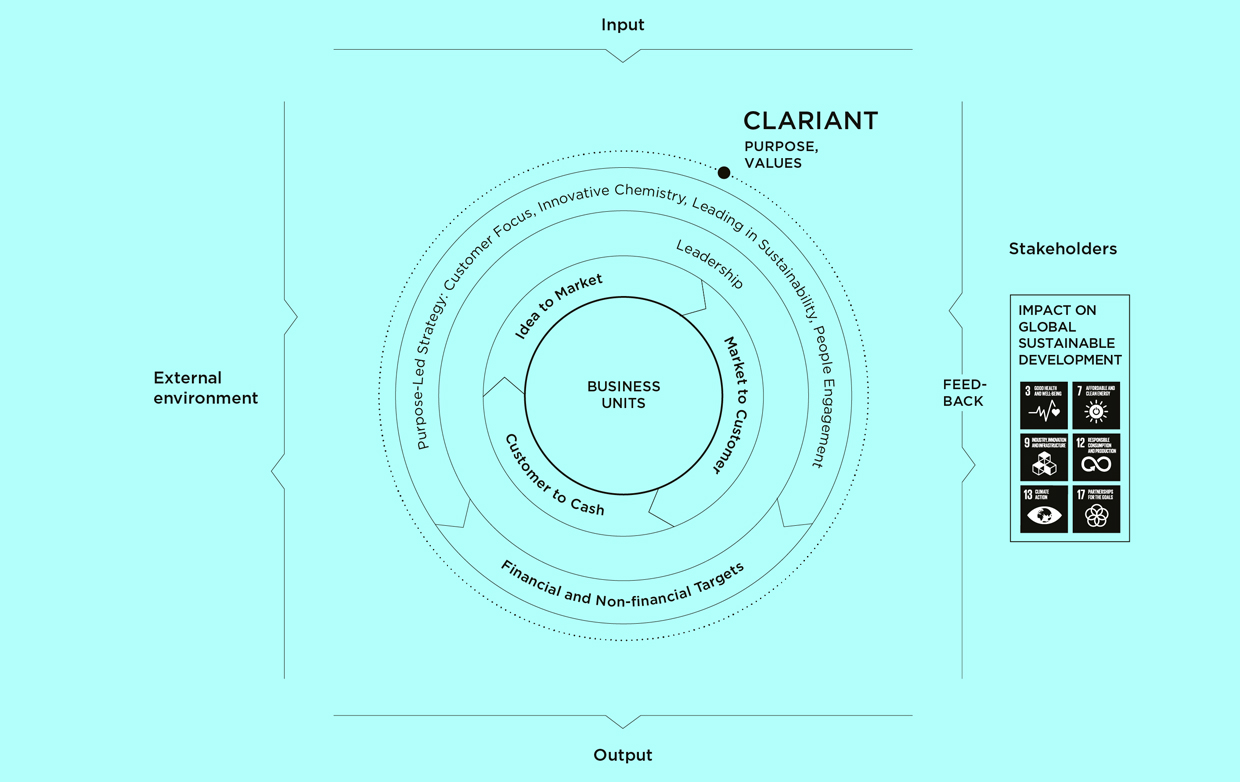
Clariant’s business model reflects how the company creates longterm value for all stakeholders – customers, employees, shareholders, and the environment. It offers a detailed overview of the company’s multidimensional approach to value creation, covering both tangible and intangible, financial and non-financial aspects of the business.
 

Clariant Image Business Modell
Close

Idea to Market

This process involves scouting global trends, identifying business opportunities, exploring unmet customer needs, developing products, and commercializing and monitoring business performance. It is essential for developing a well-filled product and service pipeline that delivers innovations to address customer needs.

Market to Customer

This process includes assessing market attractiveness, developing clear value propositions, and capturing the value created through the relationship-building and sales processes. To achieve a seamless customer experience, these steps are well-connected and focused on customer needs.

Customer to Cash

This process balances supply and demand, optimizing sourcing for spend effectiveness, monitoring production efficiency, and delivering finished goods to customers on time and in full to achieve safe, reliable, and efficient operations that support profitable growth.

Financial and Non-financial targets

The four dimensions of the purpose-led strategy are reflected in Clariant’s medium-term financial and 2030 non-financial targets. They reflect Clariant’s ambition to achieve top-quartile results in specialty chemicals in terms of growth, profitability, sustainability, and people.

Leadership

The Executive Steering Committee (ESC) is authorized by the Board of Directors to steer the company. It has overall strategic and financial responsibility, including for Clariant’s profit and loss statement. The ESC consists of the Chief Executive Officer (CEO), the Chief Financial Officer (CFO), and the three Business Presidents. Together with the Chief Human Resources Officer, the Chief Technology & Sustainability Officer, the Chief Corporate Development Officer, and the General Counsel, the ESC forms the Executive Leadership Team (ELT). By bringing all key functions together, Clariant ensures fast decision-making while incorporating all internal stakeholders’ needs.

Purpose

Clariant’s purpose »Greater chemistry – between people and planet« unites the four most important themes for the company: Customer Focus, Innovative Chemistry, Leading in Sustainability, and People Engagement.

Purpose-Led Strategy

Based on its purpose, »Greater chemistry – between people and planet,« Clariant follows a purpose-led strategy with four dimensions, accompanied by financial and non-financial targets. 

Business Units

Clariant conducts its business through three Business Units: Care Chemicals, Catalysts, and Adsorbents & Additives.

External environment

Societal trends and market drivers

Input

Resources and relationships that Clariant draws upon for its business activities (e.g., R&D spend, raw material procurement, new employees hired, training hours provided, energy consumption, water intake)

Output

Results from Clariant’s business activities (e.g., sales, return on invested capital (ROIC), EBITDA margin, lost-time accident rate (LTAR), GHG emissions, wastewater)

Sustainable Development Goals (SDGs)

Clariant is committed to contributing to the Sustainable Development Goals (SDGs) of the United Nations. While the company contributes in some respect to every SDG, six priority SDGs were identified.

Stakeholders

Clariant constantly engages with its stakeholders to stay attuned to their needs and gain feedback on how to best create value for them.

Values

Clariant’s values are considered the cornerstones of the company’s culture. Since 2022, the values are »win with our customers,« »act with integrity,« »empower and include,« »perform with agility,« and »innovate for sustainability.«

Download the Integrated Report 2025

Page summary

Summarization in progress