  • Clariant Logo
  • Compartilhar
  • Contato
  • pt - US
  • Contrast
  • Buscar
  • Produtos & Soluções
  • Sustentabilidade
  • Company
  • Mídia
  • Investors
  • Careers
  • Events
Fechar
Buscar
Fechar
SDS & Document Finder
result(s)
Todos os resultados
Fechar
Facebook Twitter LinkedIn E-mail WhatsApp More Options
Fechar
Fechar
Clariant International
  • Produtos & Soluções
  • Sustentabilidade
  • Company
  • Mídia
  • Investors
  • Careers
  • Events
Início / Especialidades químicas da Clariant / Blog / Sustainability Shift – Episode 5: Green methanol
Blog
Resumir
dezembro 20, 2023

Sustainability Shift – Episode 5: Green methanol

Podcast Customer focus Innovative chemistry Leading in sustainability Catalysts Automotive and Transportation
Renewable methanol not only opens new pathways for sustainable feedstocks but also for energy sources, especially as a fuel in maritime transport. However, just how feasible is the widespread adoption of green methanol?

As we navigate through this transformative landscape, three industry experts will explore the opportunities and challenges in scaling up green methanol and the necessity for collaboration across industries and the entire value chain. The discussion will highlight how Clariant's MegaMax catalyst plays a crucial role in enhancing the efficiency and reliability of e-methanol production at European Energy's world's largest CO2-to-methanol plant. In the future, this renewable maritime fuel will power Maersk’s entire carbon-neutral fleet.

Experts in this episode

Anders_Brendstrup

Anders Brendstrup

Power-to-X, Vice President
European Energy

European Energy was founded in 2004 with the goal of driving the green transition and developing sustainable, fossil-free energy solutions. The multinational company has major investments in solar and wind energy projects, as well as power-to-x and carbon capture technologies. European Energy builds 1000 MW of renewable energy annually.
Norbert_Ringer

Norbert Ringer

Global Expert Syngas and Methanol Product Manager, Catalysts
Clariant

Clariant Catalysts is a global and independent manufacturer of energy-efficient catalyst technologies shaping a sustainable future for the chemical industry. The company helps to decarbonize its customers’ production processes and scale up the transition toward zero-emission chemicals and fuels.

Christoph_Krinninger

Christoph Krinninger

Business Development Manager, Catalysts
Clariant

Clariant Catalysts is a global and independent manufacturer of energy-efficient catalyst technologies shaping a sustainable future for the chemical industry. The company helps to decarbonize its customers’ production processes and scale up the transition toward zero-emission chemicals and fuels.

Key terms

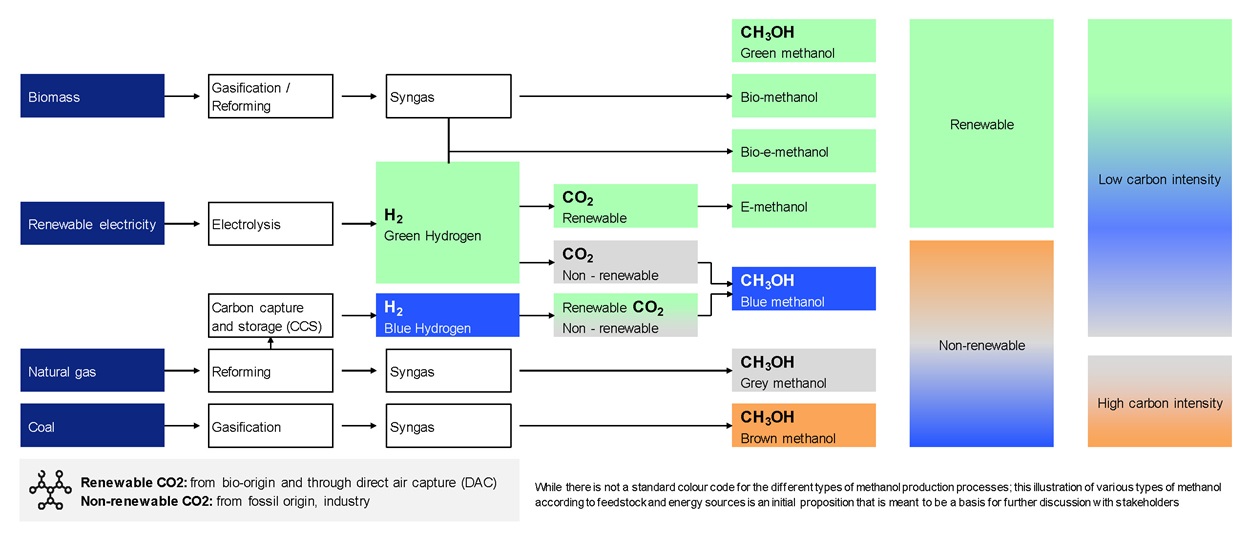
Methanol production pathways:

This image is a flowchart illustrating various types of methanol production processes based on different feedstocks and energy sources, categorized by their carbon intensity and renewability.### Feedstocks and Processes:1. **Biomass**   - Gasification/Reforming → Syngas →      - Bio-methanol (CH3OH, green)     - Bio-e-methanol (CH3OH, green)2. **Renewable Electricity**   - Electrolysis → Green Hydrogen (H2) →      - Reacts with Renewable CO2 → E-methanol (CH3OH, green)     - Reacts with Non-renewable CO2 → (grey box, no methanol product shown)3. **Natural Gas**   - Reforming → Syngas → Grey methanol (CH3OH, grey)   - Carbon capture and storage (CCS) → Blue Hydrogen (H2, blue) → Reacts with Renewable CO2 → Blue methanol (CH3OH, blue)4. **Coal**   - Gasification → Syngas → Brown methanol (CH3OH, brown)### Color Coding:- **Green**: Renewable, low carbon intensity- **Blue**: Blue methanol (low carbon intensity but non-renewable)- **Grey**: Non-renewable, high carbon intensity- **Brown**: Non-renewable, high carbon intensity### Additional Notes:- Renewable CO2 is defined as from bio-origin and direct air capture (DAC).- Non-renewable CO2 is from fossil origin or industry.- The chart highlights that there is no standard color code for methanol production processes, and this is an initial proposition for discussion.### Summary:- Green methanol types (bio-methanol, bio-e-methanol, e-methanol) are renewable and have low carbon intensity.- Blue methanol uses blue hydrogen and renewable CO2, representing a lower carbon intensity but is non-renewable.- Grey and brown methanol are non-renewable with high carbon intensity, derived from natural gas and coal respectively.If you want, I can help explain any specific part or provide a summary in a different format.

Stringent emission standards in Emission Control Areas (ECAs): An Emission Control Area (ECA) is a sea area in which stricter controls to minimize airborne emissions from ships are established. Ships sailing in emission control areas will have to use fuel oil on board with a sulphur content of no more than 0.10% (mass by mass), compared to 3.5% previously.

2023 International Maritime Organization (IMO) Strategy: The 2023 IMO GHG Strategy outlines a goal to decrease the carbon intensity of global shipping, measured as a reduction in CO2 emissions per transport work, by a minimum of 40% by 2030. Additionally, the strategy sets forth an enhanced objective regarding the adoption of zero or near-zero greenhouse gas (GHG) emission technologies, fuels, and/or energy sources, aiming for them to constitute at least 5%, with an aspiration for 10%, of the energy utilized by international shipping by 2030.

230626_Clariant_GC_Sustain_Podcast_Template_Podcast_Profile_Image

Welcome to Sustainability Shift, the Clariant Podcast. Join us as we explore sustainability trends in the chemical industry, covering circularity, climate change, bioeconomy, zero waste and pollution, and social value creation. In a series of short episodes, industry experts will share their unique insights, challenges, and innovative solutions, providing a comprehensive understanding of how the chemical industry can play a role in creating Greater chemistry – between people and planet.

More podcast episodes

  • Sustainability Shift – Episode 4: E-fuels
    Welcome to Sustainability Shift, the Clariant Podcast. In this fourth episode, two industry experts will delve into the opportunities and challenges of innovations to scale up electric fuels.
    mais
  • Sustainability Shift – Episode 3: Cosmetic ingredients
    Welcome to Sustainability Shift, the Clariant Podcast. In this third episode, we'll hear from three experts discussing the opportunities and challenges related to the sustainability shift in the cosmetics industry.
    mais
  • Sustainability Shift – Episode 2: Portfolio Sustainability Assessments
    Welcome to Sustainability Shift, the Clariant Podcast. In this second episode, three industry experts discuss how chemical companies assess the sustainability performance of their portfolio, beyond climate change
    mais
See all articles
Clariant International
          Clariant International
          Criamos valor quando reconhecemos as necessidades de nossos clientes – fornecendo soluções competitivas e inovadoras. As necessidades dos nossos colaboradores – adotando nossos valores corporativos. As necessidades dos nossos acionistas – alcançando rentabilidade acima da média. E as necessidades do meio ambiente – agindo de maneira sustentável.
          Social
          • Termos de uso
          • Expediente
          • Data protection and privacy
          Copyright © Clariant 2024. Todos os direitos reservados.

          Resumo da página

          close
          Resumo em andamento
          O resumo da página é gerado por IA