• Clariant Logo
  • Share
  • Contact
  • en - US
  • Translate
  • Contrast
  • Search
  • Products & Industries
  • Sustainability
  • Company
  • Media
  • Investors
  • Careers
  • Events
Close
Search
Close
SDS & Document Finder
result(s)
All Results
Close
Facebook Twitter LinkedIn E-Mail WhatsApp More Options
Close
Close
The translation will be performed automatically using AI. Please double-check important facts and statements.
Close
Clariant International
  • Products & Industries
  • Sustainability
  • Company
  • Media
  • Investors
  • Careers
  • Events
Home / Products & Industries / Paints & Coatings / Digital Formulations Factory Coatings – Optimize y…
Paints and Coatings
Summarize

Digital Formulation Factory Coatings

The Digital Formulation Factory (DFF) is Clariant's cutting-edge high-throughput experimentation platform designed specifically for the paints and coatings industry. This innovative service combines advanced automation, predictive modeling, and industry-standard testing to transform how you develop and optimize paint formulations.

Watch the video to learn more

Benefits

Clariant_Load

Automized platform running 24/7

Clariant_Maximum Precision_Pipette

Integrated application tests based on industry standards

Clariant_Icon_Tailored Solutions_Circle_Pair of Compasses
 

High reproducibility of experiments with proven reliability

Clariant_Magnifying Glass
 

Screen your additives and ours in standard or custom paint formulations

Clariant_SEO
 

Easily scale up volumes of experiments, ideal for extensive research projects

Automated application tests available for High Throughput Platform
Standard tests
Proprietary tests
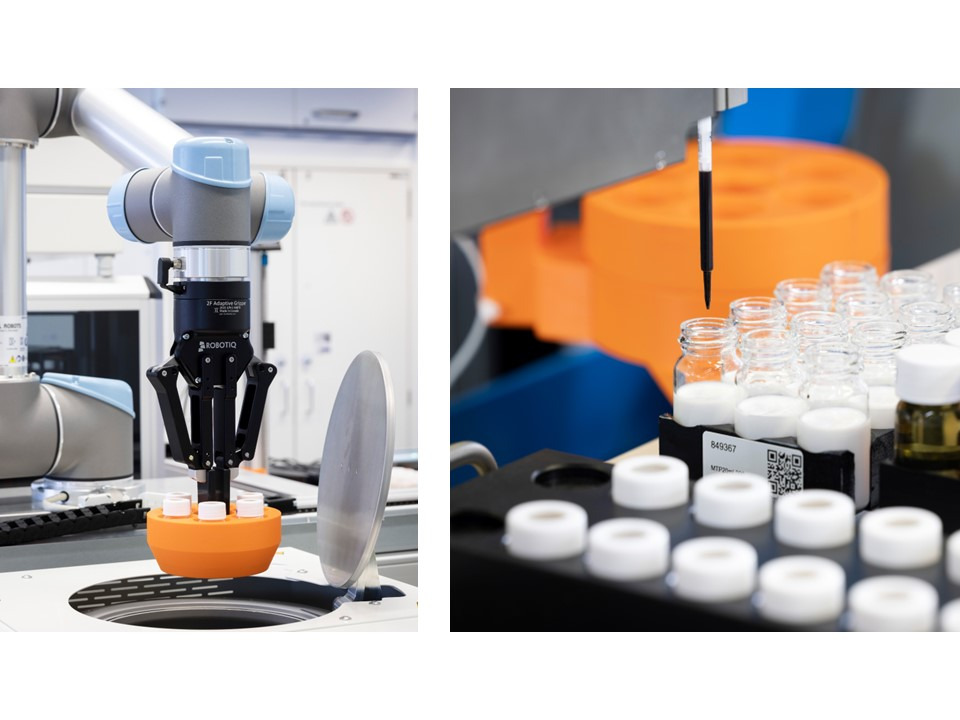
The image appears to depict a series of automated processes involved in laboratory or industrial settings, likely related to chemical or pharmaceutical production. Each section of the image corresponds to a specific process:

1. **Dispensing**: This involves the precise measurement and delivery of liquids or powders, often using automated pipettes or dispensers.

2. **Formulation**: This step involves combining various ingredients to create a specific product or compound, often requiring precise measurements and mixing.

3. **Mixing**: This process ensures that all components are evenly distributed within a solution or mixture, often using automated mixers or stirrers.

4. **pH Measurement**: This involves determining the acidity or alkalinity of a solution, typically using pH meters or probes.

5. **Stability**: This section mentions "Syneresis" and "Sedimentation," which are processes related to the stability of mixtures. Syneresis refers to the separation of liquid from a gel-like substance, while sedimentation involves the settling of particles within a liquid.

6. **Rheology**: This involves studying the flow and deformation of materials, often using rheometers to measure viscosity and other flow properties.

Overall, the image highlights the use of automation and robotics in conducting these processes, likely to improve efficiency, accuracy, and consistency in laboratory or industrial settings.
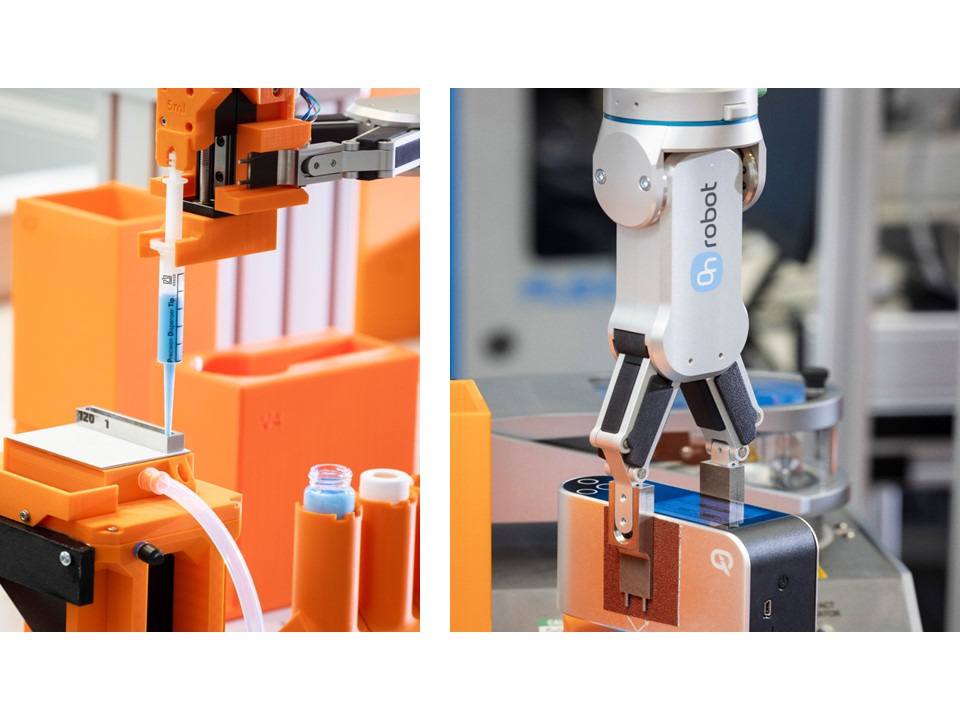
The image appears to depict a series of automated or robotic processes used in a laboratory or industrial setting, likely related to material testing or quality control. Here's a breakdown of the processes shown:

1. **Draw-down**: This process involves applying a uniform layer of material, such as paint or coating, onto a surface. The thicknesses mentioned (120 µm, 200 µm, 400 µm) indicate different levels of application thickness.

2. **Photometric analysis**: This involves measuring various optical properties of materials. The specific analyses listed include:
   - Color strength: Evaluating the intensity or vividness of a color.
   - Rub out: Testing the durability or resistance of a surface to rubbing.
   - Gloss/Haze: Measuring the shininess or clarity of a surface.
   - Hiding power: Assessing the ability of a coating to obscure the surface beneath it.

3. **Freeze thaw (Viscosity)**: This likely refers to testing the stability of a material's viscosity (thickness or resistance to flow) under freeze-thaw cycles, which simulate environmental conditions.

4. **Cross cut**: This is a method used to assess the adhesion of a coating to a substrate by making cuts in a grid pattern and evaluating how well the coating adheres.

5. **Wet-scrub**: This test measures the resistance of a coating or surface to scrubbing with water, which is important for evaluating durability and cleanability.

6. **Microbiology**: This section likely involves testing for microbial contamination or resistance, which is crucial for materials used in environments where hygiene is important.

Overall, the image suggests a comprehensive approach to testing and analyzing materials, possibly in the context of coatings, paints, or similar products.

Download our DFF flyer with more information

  • Flyer DFF Digital Formulation Factory Coatings EN 2026 (0.87 MB)

Download File

Close
  • Newsletter sign-up

Related resources

ClariCoat
Clariant’s new digital assistant for choosing the right additive for your paints
More

Contact us

back to top
Clariant International
          Clariant International
          We at Clariant are aware of our responsibility. Our purpose »Greater chemistry – between people and planet« describes the role we can play in the world if we align our thinking and all future decisions with it.
          Social
          • Imprint
          • Terms of Use
          • Data protection and privacy
          • General Terms and Conditions of Sale and Purchase
          Copyright © Clariant 2026. All rights reserved.

          Page summary

          close
          Summarization in progress
          The page summary is generated by AI