
A paternity test
FOR YOUR T-SHIRT
In these days of fast fashion, looking out for how our clothes are made has become a common habit, yet one that isn’t always easy to follow. In the summer of 2019, a large global fashion brand was called out by Norway’s consumer authority for failing to sufficiently prove the sustainability of its garments, misleading shoppers.
To make things worse, even if organic or ethical certificates are provided, some say this isn’t always enough. The paper-based or digital trails these certificates rely on can be manipulated – so that manufacturers and brands themselves may be misled.
To solve this issue, a Swiss start-up has invented a technology that makes it possible to track raw materials and products with the oldest and most incontrovertible proof of origin there is: DNA. Fascinated by the method and its sustainability- and trust-enhancing potential, Clariant has acquired a stake in the company and is now closely cooperating with it to expand the technology to new applications.
The start-up is called Haelixa and was created as a spin-off from Switzerland’s most renowned technical university, the Federal Institute of Technology (ETH). By developing DNA-based tracers that practically become part of materials and objects, the ETH scientists found a new way to make supply chains more transparent, prove the provenance of goods, and combat counterfeiting by ensuring product authenticity.
Haelixa’s tracers consist of tiny strands of harmless DNA that have been enclosed in robust spheres of inorganic oxides to protect them from natural degradation, heat and chemicals. Each sphere is more than a thousand times smaller than a grain of sand, and they can be sprayed onto solid materials or simply be stirred into liquid ones. The uniquely coded tracers then stay with the material throughout the entire supply and processing chain – and in the end offer definite proof of its origin.
This proof is obtained in pretty much the same way as in a paternity test. A sample of the material is used to extract the DNA, which is then multiplied to identifiable amounts with a process called polymerase chain reaction. Testing can be done in the lab or in the field, and the method is so sensitive that even tracers that have only been added in the parts-per-billion range can be detected. Results are ready in about an hour and so accurate that they not only reveal the authenticity of products but can also show whether a material has been diluted with other materials.
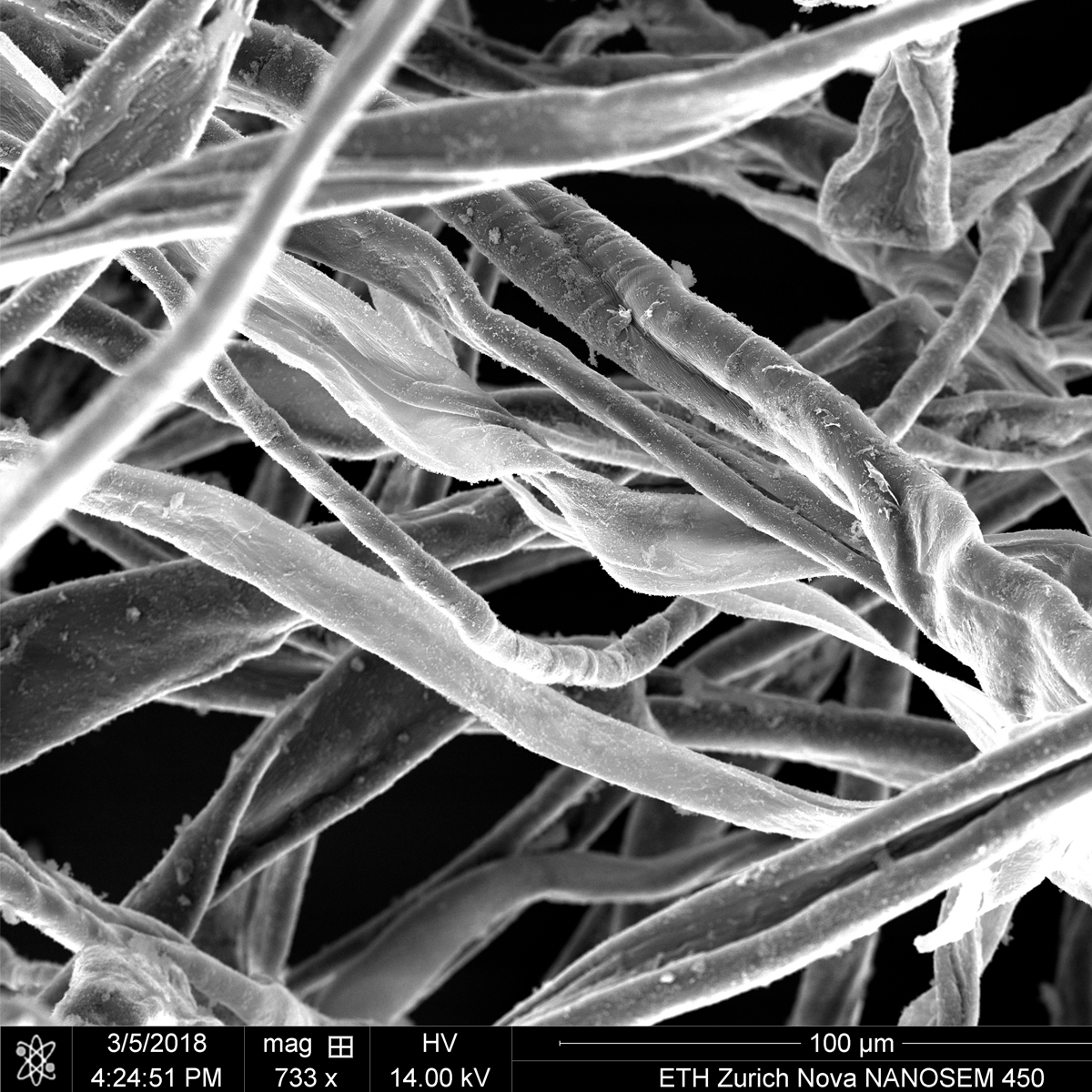
While all this may sound like something you’d rather expect in an episode of CSI than in a business setting, advances in DNA technology actually make it quite easy. Manufacturers simply order their batch of unique DNA tracers, apply them to raw materials or elsewhere in the supply chain, and can even do the paternity test themselves instead of sending the samples to Haelixa. The company has a very nice video about how all this works with sustainable cotton for T-shirts, and a venerable Swiss jewelry company is already using the technology to prove the ethical provenance of its gemstones.
Since starting to cooperate with Haelixa, Clariant has also been keen to harness its wide-ranging expertise to put the method to good new uses. Just around the same time of last year’s complaints about misled fashion consumers, for instance, the EU struck out against counterfeiters trying to mislead farmers. Coordinated by Europol, operation Silver Axe cracked down on airports, harbors and production facilities in nearly 30 countries. The counterfeit pesticides seized were enough to potentially poison fields with a combined size of Estonia.
To prevent the involved risks to health and nature, as well as the over one billion euros in yearly damage done to real producers, Clariant and Haelixa have adapted the DNA-tracers for use in agrochemicals. Following the opposite route to cotton, these can now be safely tracked from the factory to the field, where just a few milliliters are enough to reveal any attempt at fraud or adulteration. We have also found a way to make traceable coatings for crop seeds, packaging and finished goods, and are now looking to expand the range of solutions to natural products with sensitive origins, such as palm oil.
We are sure that, like in a polymerase chain reaction, many other excellent ideas for using the great technology will quickly turn up. If you have one you’d like to contribute, please feel free to use the contact box in the right column to let us know about it.