
Clariant successfully concludes testing of energy crop miscanthus at Straubing plant for GRACE project
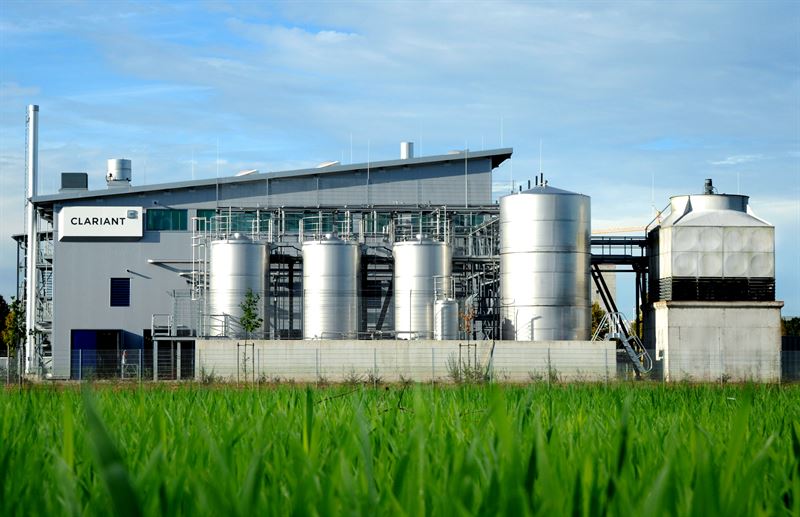
- INA has chosen Clariant’s sunliquid® technology to assess usability of miscanthus for conversion into lignocellulosic sugars & ethanol within the EU-funded GRACE project in which INA participates
- About 30 tons of miscanthus were processed at Clariant’s pre-commercial plant in Straubing, Germany
- sunliquid proved good performance with miscanthus feedstock during testing
Munich, September 02, 2019 – Clariant announced today that it has conducted tests on approximately 30 tons of miscanthus provided by INA, Croatia’s leading oil and gas company. The miscanthus biomass was harvested and baled at the INA demonstration site in Croatia in February this year and shipped for processing to Clariant’s pre-commercial sunliquid plant in Straubing, Germany for conversion into lignocellulosic sugars and ethanol.
INA is a consortium member of the publicly funded project “GRowing Advanced industrial Crops on marginal lands for biorEfineries” (GRACE www.grace-bbi.eu). The GRACE project has received funding from the „Bio-based Industries Joint Undertaking“(BBI JU) under the European Union’s Horizon 2020 research and innovation programme. The consortium consists of 22 partners from universities, the agricultural sector and the industry.
The aims and objectives of the project are to optimize various miscanthus value chains, to produce sustainable products with a strong market potential and to develop miscanthus as a sustainable feedstock resource for cultivation on marginal, contaminated and abandoned land. Against this background, Clariant was asked by the GRACE consortium to run tests of miscanthus as a feedstock for the production of lignocellulosic sugars and ethanol.
Final results prove that the sunliquid technology can successfully convert miscanthus biomass into lignocellulosic sugars and ethanol, confirming the benefits of the sugar process platform. Thanks to the flexible sunliquid process design, lignocellulosic sugars can be generated as an intermediate product that have the potential to serve as a building block for future production of bio-based chemicals. Making further use of Clariant’s proprietary enzyme platform for feedstock specific enzymes can finally open up the full potential of this promising energy crop.
“We are very pleased to work with renowned partners such as INA and other GRACE consortium members. These feedstock tests constitute an important milestone for Clariant. It is for the first time that we tested miscanthus – a high yielding and robust energy crop - in our pre-commercial plant in Straubing. Once again, this showed the flexibility and efficiency of the sunliquid technology platform when it comes to different lignocellulosic feedstock”, emphasizes Dr. Markus Rarbach, Head of Business Line Biofuels and Derivatives at Clariant.
“As the bioethanol demonstration case leader of the EU-funded GRACE project, we are satisfied with the testing results. These results are a push towards further development of a bio-based value chain and a circular bio-economy for further commercial conditions”, said Stjepan Nikolić, Operating Director of Refining and Marketing at INA.
This demonstrates that miscanthus, also known as elephant grass or China reed, proves itself as an interesting feedstock option for the production of lignocellulosic sugars and ethanol. Once cultivated in marginal lands, the plant grows rapidly over 15-20 years as a permanent crop, has a low mineral content and offers a high yield per hectare. Pesticides and fertilizers are not required on a yearly basis, which further adds to miscanthus’ ecological benefits.
Over the past seven years Clariant’s pre-commercial plant has also demonstrated cellulosic ethanol production on agricultural residues such as corn stover, sugarcane bagasse and straw as well as wheat, barley and rice straw. In the fall of last year, Clariant broke ground on its greenfield first-of-its-kind full-scale commercial cellulosic ethanol plant in Podari, the southwestern region of Romania. The new plant, with an annual production capacity of 50.000 tons, will be a flagship site, confirming competitiveness and sustainability of the sunliquid technology at commercial scale thus supporting Clariant’s sunliquid licensing business strategy.
SUNLIQUID® IS A TRADEMARK OF CLARIANT REGISTERED IN MANY COUNTRIES.
