  • Clariant Logo
  • Share
  • Contact
  • en - US
  • Translate
  • Contrast
  • Search
  • Products & Industries
  • Sustainability
  • Company
  • Media
  • Investors
  • Careers
  • Events
Close
Search
Close
SDS & Document Finder
result(s)
All Results
Close
Facebook Twitter LinkedIn E-Mail WhatsApp More Options
Close
Close
The translation will be performed automatically using AI. Please double-check important facts and statements.
Close
Clariant International
  • Products & Industries
  • Sustainability
  • Company
  • Media
  • Investors
  • Careers
  • Events
Home / Products & Industries / Catalysts / Energy Transition / Hydrogen distribution
Energy Transition
Summarize

Hydrogen Distribution
Revolutionary catalysts
for the energy transition

Green hydrogen from renewable energy sources, such as wind and hydro power, can be an abundant, versatile, and clean energy source. Consequently, there’s great interest in an energy transition away from fossil fuels toward a hydrogen economy, with the goal of decarbonizing transport and industry. There’s just one problem with hydrogen: its high volatility and very low density make it difficult and expensive to transport over long distances.

The most economically viable solution is to chemically convert hydrogen into a safer form for transportation, then reconvert it at point of use. There are currently two effective ways to »carry« hydrogen: via LOHCs, or ammonia. Clariant is proud to be one of the frontrunners in developing highly specialized catalysts for both pathways.

Hydrogen Transport via LOHCs

Process

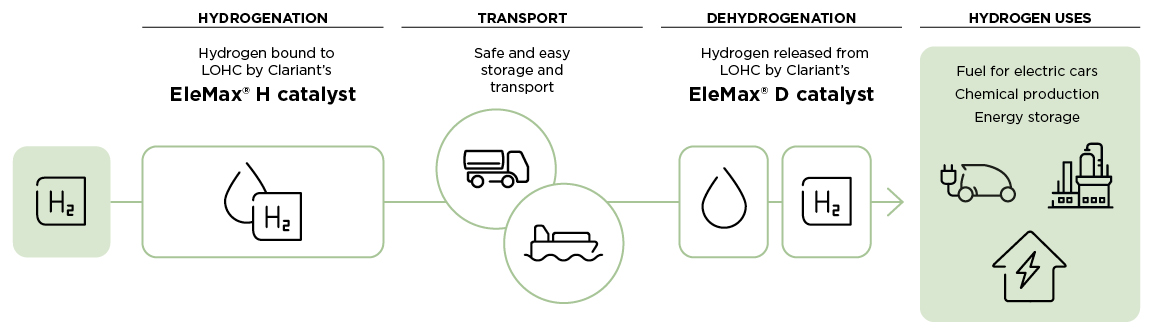
Liquid organic hydrogen carriers (LOHCs) are an ingenious means of transporting hydrogen by chemically binding the molecules. Developed by Hydrogenious Technologies, the method involves hydrogenation of the liquid organic hydrocarbon benzyltoluene using Clariant’s EleMax™ H catalyst to “store” hydrogen. At point of use, dehydrogenation with EleMax™ D »releases« hydrogen on demand. The tailor-made catalysts offer exceptional activity and selectivity for loading and unbinding hydrogen in order to optimize the life cycle and efficiency of LOHCs.

Clariant Image Graphic Hydrogen Transport LOHC  20220513

Hydrogenious Technologies’ revolutionary solution and Clariant’s specialized catalysts present a safer, more efficient alternative for storing and transporting high volumes of hydrogen.

For further information, please visit Hydrogenious LOHC Technologies

Any questions? Get in contact

  • Plastic recycling
    Chemical plastic recycling is essential if we are to reduce the growing environmental burden of plastic waste.
    more
  • Blue hydrogen
    Catalysts to optimize the efficiency of blue hydrogen production
    more
  • Carbon capture and utilization
    Catalysts for sustainable fuels and chemicals via power-to-x
    more
  • Feed purification
    Catalysts for upgrading syngas, CO₂, and green or blue H₂
    more
Clariant International
          Clariant International
          We at Clariant are aware of our responsibility. Our purpose »Greater chemistry – between people and planet« describes the role we can play in the world if we align our thinking and all future decisions with it.
          Social
          • Imprint
          • Terms of Use
          • Data protection and privacy
          • General Terms and Conditions of Sale and Purchase
          Copyright © Clariant 2026. All rights reserved.

          Page summary

          close
          Summarization in progress
          The page summary is generated by AI