
Refinery Off-Gas Purification: Clariant's solutions for enhanced process safety and ethylene recovery


Refinery off-gases from catalytic cracking units such as FCC, DCC, coker, hydrocracker, reformer, and other units are typically utilized as fuel gas. Yet these streams often carry significant recoverable value in ethylene, propylene, hydrogen, ethane, propane, and heavier hydrocarbons. Recovering that value safely and economically is the challenge. Clariant solves it.
70 years. 36+ references. A global track record in refinery off-gas purification.
Clariant is a global leading catalyst manufacturer with over 70 years of catalyst expertise and innovation, uniquely positioned with state-of-the-art production facilities and know-how across an exceptionally wide range of catalyst materials and manufacturing capabilities.
With over 36 licensed references and catalysts treating over 500 MT/hr of off-gas worldwide, we bring proven, field-tested solutions to every project. This depth of commercial experience and field data gives Clariant the expertise to support, diagnose and solve the complex refinery off-gas challenges. This global reference base covers stand-alone Ethylene Recovery Units (ERU), Propylene Recovery Units (PRU), as well as integrated refinery–steam cracker configurations, supported by Clariant's expertise at every project stage, from initial feasibility and R&D through to commercial startup and long-term operations.
Clariant's knowledge of the chemistry, catalysts, adsorbents, and operating conditions behind refinery off-gas processing is what drives the design of every purification package. Across 36+ commercial references, Clariant has developed a precise understanding of the trade-offs between ethylene capture, catalyst selectivity, and process safety, and applies that understanding to build configurations that meet each project's specific recovery and reliability objectives.

70+
years of catalyst
experience

500 MT/hr
of off-gases treated
worldwide

36+
Licensed references
Safer operations, higher olefin yields, and greater feedstock flexibility with Clariant

Improved Safety: Clariant's purification systems reduce oxygen and NOx concentrations to safe levels before cryogenic processing, protecting cold boxes, plate-fin exchangers, and brazed aluminum heat exchangers from unstable compound accumulation.

Feedstock Flexibility: Clariant's catalyst portfolio handles the full range of refinery off-gas compositions, from high-sulfur complex feeds to clean, low-contaminant streams.

Multiple Process Configurations: Treatment packages support stand-alone Ethylene Recovery Units (ERU), Propylene Recovery Units (PRU), and integrated configurations with existing ethylene plants.

Increased Olefin Yields: Clariant's selective catalysts remove impurities while minimizing ethylene and propylene loss, maximizing the recoverable value of every off-gas stream.

Carbon efficiency: Clariant's catalysts for refinery off-gas purification help refineries and crude-to-chemical complexes reduce their environmental footprint, contributing to the 45 million tons of CO2e avoided by Clariant customers in 2025, based on internationally recognized carbon reduction methodology.
PODCAST: How catalysts turn refinery off-gas streams into valuable products
Holli Garrett, Global Product Manager for Ethylene at Clariant Catalysts, joined Lee Nichols, Editor-in-Chief of Hydrocarbon Processing, to discuss refinery off-gas treatment and the value these streams can deliver.
Listen to Holli Garrett talking about how refinery off-gas treatment has changed over the years and why refiners are taking a closer look at the value sitting in these streams.
Holli Garrett goes deeper in this second episode, discussing the complexities of refinery off-gas treatment and focusing on designing effective catalyst treatment packages tailored to specific gas streams. Listen to her perspective on the key challenges, technologies, and industry trends.
PODCAST
Part 1, June 3, 2026
Hydrocarbon Processing
PODCAST
Part 2, August 19, 2026
Hydrocarbon Processing
"Refinery off-gas enables the efficient use of every molecule across the refinery-petrochemical value chain. This creates value through improved profit."
Holli Garrett
Product Manager Ethylene
Clariant Catalysts

Impurity control is the foundation of safe off-gas processing
Why impurity control matters
Reactive impurities of oxygen, NOx, acetylene, and diolefins in refinery off-gas streams pose serious safety and operational risks in cryogenic separation systems. Removal before the cold section is critical: at low temperatures, unstable compounds can accumulate in cold boxes and heat exchangers, threatening equipment integrity and personnel safety.
Key Hazards
- NOx: In the presence of oxygen and unsaturated hydrocarbons, NOx forms unstable compounds under cryogenic conditions, creating risks during operation, shutdown, or upset events.
- Oxygen: Promotes reactions with NOx and reactive hydrocarbons, forms hazardous compounds, and degrades downstream catalyst performance.
Clariant's solutions: End-to-end purification packages
Clariant designs customized purification systems based on feed composition, pressure, sulfur content, contaminant profile, and recovery objectives. Each package is backed by 36+ operating references.
Applications: Supports standalone refinery and integrated refinery–ethylene plant configurations, improving project economics and long-term unit reliability.
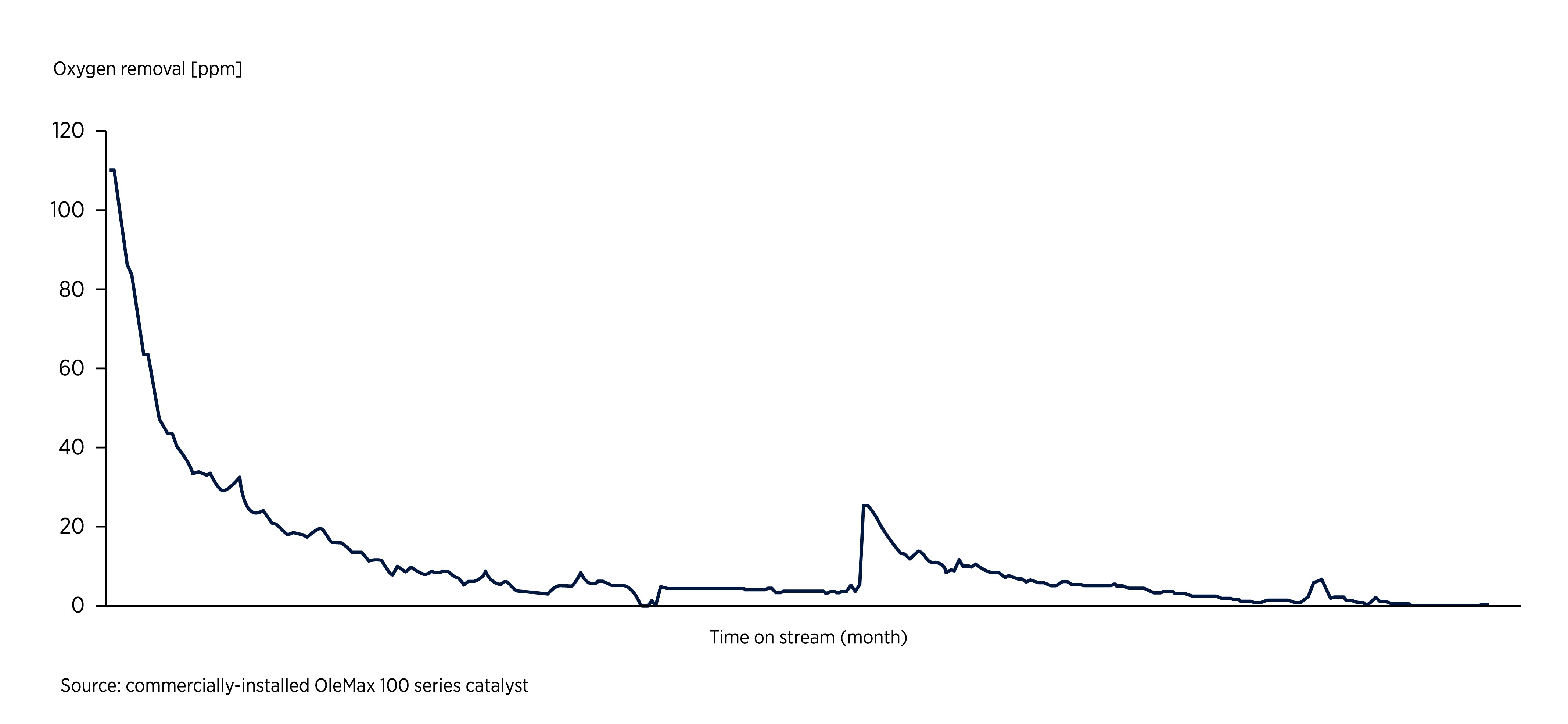
Oxygen removal performance of Clariant OleMax 100 Series Catalyst in commercial operation
This graph shows outlet oxygen concentration in ppm over time for a commercially installed OleMax 100 series catalyst unit. Following an initial conditioning period, the catalyst consistently reduces oxygen to near-zero ppm across an extended operational period. A temporary feed upset mid-operation caused a brief concentration spike of approximately 25 ppm before the catalyst returned to near-zero performance. The data demonstrates that OleMax 100 delivers reliable, sustained oxygen removal in real refinery off-gas conditions, including tolerance to feed fluctuations.
Clariant’s broad refinery off-gas catalyst portfolio: the right solution for every feed and every project
Clariant offers treatment approaches for refinery off-gas purification, each tailored to specific feed compositions, contaminant profiles, and recovery objectives. The right catalyst and adsorbent package as well as configuration depends on the stream composition and downstream requirements, which is why Clariant designs every package around detailed feed characterization.
Technology Best Application Contaminants Targeted Key Performance Feature OleMaxTM 100 Complex, variable, sulfur-containing feeds O2, NOx, acetylene Sulfur-tolerant; handles feed fluctuations more likely to achieve ethylene product specifications OleMaxTM 120 Low-sulfur streams where ethylene recovery is the highest priority O2, NOx, acetylene Low ethylene loss; lower-temperature operation ActiSorbTM Guard Media Upstream guard beds Mercury, arsine, phosphine, heavy metals and other contaminants Protects downstream catalyst life AdsorbMaxTM Regenerative sulfur removal and final polishing Residual trace impurities Regenerable; achieves ppb-level purity
Full project lifecycle support - From feasibility to commercial operations
Clariant supports refinery off-gas projects at every stage, from initial feasibility assessments and R&D through engineering design, commissioning, and ongoing commercial operations. Clariant works directly with technology licensors, as well as with EPCs and plant operators, to ensure purification systems are properly specified, installed, and optimized.
Clariant's support offering includes:
- Engineering consultation for feed characterization, reactor sizing, and configuration selection
- Stand-alone ERU and PRU configurations, as well as integrated designs with existing ethylene plants
- Crude-to-chemicals project support for deeper refinery–petrochemical integration
- Digital web-based support interface for quick troubleshooting and ongoing unit performance optimization
- Operator training programs tailored to site-specific purification systems
Discover our Refinery Off-Gas Purification brochure
Turn your off-gas into opportunity. Ready to maximize your off-gas value?
Clariant's experts can assess your specific stream, identify the right catalyst configuration, and support your project from first feasibility through commercial operation.
Frequently asked questions
What is refinery off-gas and why does it matter?
Refinery off-gas refers to light hydrocarbon gas streams generated across refineries and various processing operations. Its composition varies significantly depending on the source unit.
Refinery off-gas has historically been routed to fuel gas systems for use in furnaces, boilers, and process heaters, valued mainly for its heating content rather than its chemical potential.
The petrochemical industry is focused more on safety, carbon efficiency, and molecule value. Off-gas streams from refineries and other process operations contain valuable components, such as ethylene, propylene, hydrogen, and light hydrocarbons, that can be worth more as petrochemical feedstocks than as heating fuel.
The main challenge is variability between streams from different units, combined with the fact that trace contaminants, measured in ppm or even ppb, can have a major impact, requiring treatment that is selective enough to remove impurities while preserving valuable olefins.
Why purification matters
Refinery off-gas typically contains oxygen, Nitrogen Oxides (NOx), acetylene, diolefins, sulfur species, mercury, arsine, phosphine, methyl acetylene, propadiene, and butadiene, all of which can create downstream safety, reliability, and product-quality issues if not managed properly.
Clariant has developed a deep understanding of the purification of these off-gases through operating references and working in close collaboration with process technology providers. Clariant is in a unique position to understand most purification requirements and has the experience and know-how to support any situation.
One well-established chemical pathway involves trace nitrogen oxide (NO) and oxygen contamination. Under cryogenic conditions, nitric oxide can be converted to nitrogen trioxide (N₂O₃), a highly reactive compound. In the presence of olefins and ammonia, N₂O₃ forms nitrated oligomers (NOx gums) and ammonium-based NOx salts, respectively. These compounds have been found in low-temperature sections such as the feed to the demethanizer and within brazed aluminum plate-fin heat exchangers (BAHX), where their formation can lead to plugging, corrosion, and detonation hazards.
Additionally, NOx accumulation has been reported in sections of the furnaces, where air ingress enables partial oxidation reactions. It also occurs in transfer lines from pyrolysis furnaces to primary quench exchangers, where residual NO may mix with entrained oxygen or ammonia. It occurs in steam dilution zones, especially if poorly drained or operated under varying pressures, allowing condensed phases to pool. It also occurs in knock-out drums and cold traps during start-ups or shutdowns, where flow velocity and turbulence are reduced.
Can Refinery Off-Gas Purification be economical?
Refinery off-gas typically contains ethylene, propylene, hydrogen, methane, ethane (5–30 mole %) and other hydrocarbon. Gas composition is different in each case. The Clariant catalyst portfolio is used to custom-build around the operator's needs and objectives. The treatment package ensures that the refinery off-gas purification is robust to ensure safe processing of the gas, which maximizes the recovery of olefins such as ethylene and propylene.