
A seamless switch from fossil to renewable carbon in hot melt polymers

On the go? Click here to listen to this post in our podcast!

Delivering on Clariant's purpose »Greater chemistry - between people and planet.«
This story is an example of how Clariant delivers on its purpose-led strategy.
Hot melt polymers must deliver consistent performance under demanding conditions. Formulators rely on predictable viscosity, strong cohesion, stable processing behavior, and a consistent low odor environment from batch to batch.
Licocene™ Terra was developed to help adhesive formulators integrate renewable carbon into their formulations while maintaining familiar processing behavior and performance contribution. As part of the Licocene m-PO specialty polymer portfolio, it combines established performance characteristics with verified renewable feedstock through an ISCC PLUS-certified mass balance approach.
For formulators, this provides a drop-in pathway to reduce reliance on fossil carbon without redesigning existing adhesive systems.
What is Licocene Terra?
Licocene Terra is a sustainable m-PO polymer designed as a formulation component for hot melt adhesives and other industrial applications. It is a drop-in solution that integrates renewable, bio-based feedstock into the production process while maintaining the processing stability and formulation compatibility known from conventional Licocene grades.
Instead of introducing a completely new material concept, Licocene Terra builds on established m-PO technology, which makes it easier for formulators to adopt renewable carbon solutions into existing product portfolios.
Why consider renewable m-PO polymers in hot melt adhesives?
Sustainability expectations across value chains are evolving rapidly. Adhesive manufacturers are increasingly asked to demonstrate carbon transparency, prepare for carbon disclosure requirements, and support their customers’ sustainability goals.
Renewable raw materials can support formulators in several ways:
- Supporting sustainability-driven tenders and brand positioning
- Preparing formulations for emerging regulatory and carbon disclosure frameworks
- Maintaining continuity in processing and performance while shifting away from fossil carbon to renewable content
Rather than requiring formulators to redesign established adhesive systems, Licocene Terra allows manufacturers to expand how their formulations incorporate renewable carbon.
How is Licocene Terra different from conventional Licocene grades?
Licocene Terra products belong to the same performance m-PO polymer family, the carbon source is what sets them apart.
While conventional grades rely on fossil-based feedstock, Licocene Terra incorporates renewable raw materials through a mass balance production approach certified under ISCC PLUS.
This results in polymers that maintain familiar quality control, handling and formulation characteristics while offering a Renewable Carbon Index (RCI) starting at 50%, with selected grades reaching up to 100% under a mass balance approach, which means manufacturers can replace fossil carbon with renewable carbon while maintaining the processing and formulation behavior expected from the Licocene product family.
Product highlights
How does the mass balance approach work?
Mass balance can be understood as a certified accounting method for renewable raw materials. Renewable and fossil feedstocks are processed together within existing industrial infrastructure. Instead of separating the materials physically, the renewable portion is carefully tracked and allocated to specific products based on verified input and output quantities.
Independent certification bodies audit the process to ensure transparency and credibility across the value chain. A simple way to visualize mass balance is to think of renewable electricity: energy from different sources flows through one grid, while certified renewable volumes are transparently assigned.
This approach enables the integration of renewable feedstock without requiring separate production lines or changes to established manufacturing processes.
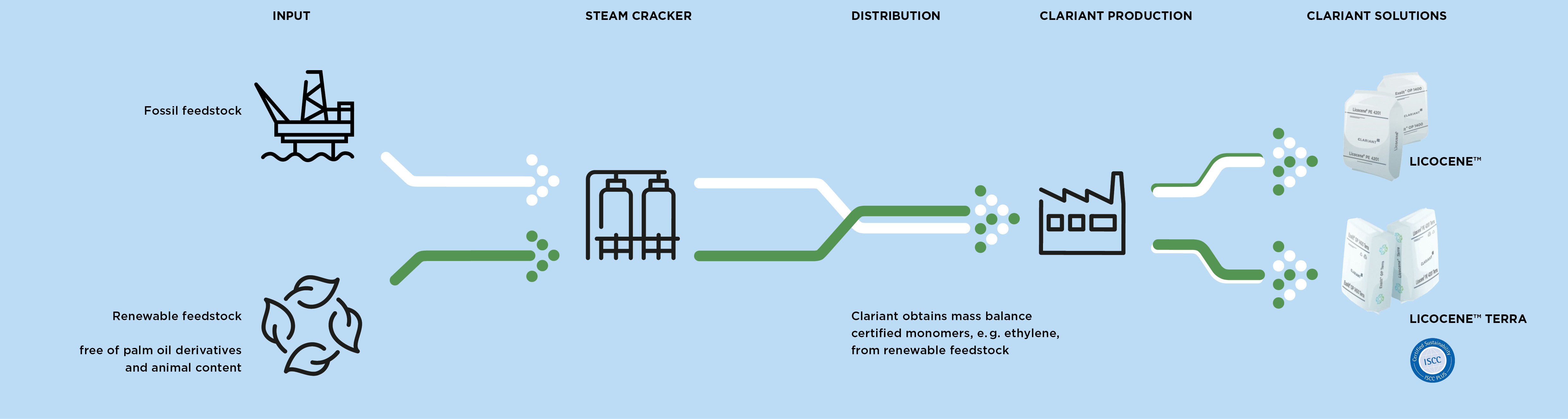
From feedstock to bio-based m-PO polymer — step by step
1. Feedstock input
Both fossil-based and renewable raw materials enter the production system. Renewable feedstock used for Licocene Terra is free from palm oil derivatives and animal content.
2. Conversion into building blocks
The feedstock is converted into chemical intermediates such as ethylene. At this stage, renewable and fossil sources are not physically separated.
3. Certification and allocation
The renewable share is tracked using ISCC PLUS mass balance certification. Auditors verify that certified output corresponds to renewable input volumes.
4. Clariant production
Mass balance certified monomers are used to manufacture Licocene Terra grades using established production technologies.
5. Final solution
Customers receive a performance bio-based m-PO polymer designed to behave like a conventional Licocene grade — but with a verified renewable carbon share.
Is Licocene Terra a drop-in solution for adhesive formulations?
Licocene Terra is designed to function as a drop-in polymer component within existing hot melt adhesive formulations. Processing windows, compatibility with common formulation components, and handling behavior remain consistent with conventional Licocene performance polymers. This allows formulators to maintain established production workflows while introducing a renewable or non-fossilraw material option.
The goal is continuity — enabling sustainability progress without disrupting proven adhesive performance.
When does Licocene Terra make the most sense?
While every application is different, certain market drivers make renewable carbon solutions particularly relevant:
- Adhesives developed for sustainability-focused consumer brands
- Packaging and hygiene applications where carbon transparency is increasing
- Projects requiring documented renewable content or certification schemes
- Formulations aimed at long-term regulatory readiness and reduced fossil dependency
In these scenarios, integrating renewable carbon content can support both technical performance and market differentiation.
What this means for adhesive formulators
For formulators, adopting Licocene Terra is less about changing performance and more about expanding formulation possibilities. Licocene Terra maintains familiar processing behavior while offering a mass balance Renewable Carbon Index of at least 50% — up to 100% for select grades — enabling adhesive manufacturers to achieve sustainability goals without sacrificing reliability or efficiency. It represents a practical step toward more sustainable - adhesive solutions, built on technology that formulators already know and trust.
Moving toward a more circular adhesive value chain
The transition toward renewable raw materials is reshaping how adhesives are developed, specified, and communicated across industries. Licocene Terra provides a pathway to integrate renewable carbon into existing formulations while supporting the broader shift toward more sustainable value chains. For manufacturers looking to combine established performance with forward-looking sustainability strategies, it offers a solution that aligns technical continuity with evolving market expectations.