
Why smarter preservation matters in baby care formulations

Delivering on Clariant's purpose »Greater chemistry - between people and planet.«
This story is an example of how Clariant delivers on its purpose-led strategy.
Learn how the Velsan™ family helps formulators balance reliable microbial control, formulation flexibility, and renewable carbon content in baby care applications.
Preserving baby care products is challenging because baby skin is still developing. The stratum corneum of infants is around 30% thinner than that of adults, and its barrier function, including water balance and acid mantle formation, is still maturing. Consequently, baby skin may be more susceptible to dryness and irritation. Therefore, applied baby care products must adhere to rigorous standards of mildness, naturalness, and effectiveness. At the same time, these products are more susceptible to contamination, so they must remain protected throughout their shelf life and during repeated use.
This context highlights the need for adapted microbial protection to be incorporated into the baby care formula from the start, not as an afterthought.
Why are baby care formulas susceptible to contamination?
Many of these products are used in warm, humid settings and are handled several times a day. Contamination can enter a product through:
- Unwashed hands or skin contact
- Water droplets and splashes
- Microorganisms transferred through the air
- Packaging that is left open
- Repeated contact with the product opening
- Accidental dilution with water
Microbial growth can compromise product quality. Microorganisms may also produce metabolites or cause ingredient degradation, potentially generating compounds that can irritate sensitive skin.
What is cross-contamination in baby care?
Cross-contamination occurs when microorganisms are transferred from hands or affected skin to a product during use. If the product formulation does not control their growth, it may become a reservoir for subsequent transfer.
Candida albicans is a yeast strongly associated with candidal diaper dermatitis and is frequently detected when diaper dermatitis is present. Controlling its growth is therefore particularly relevant when validating diaper-care formulations. It does not treat dermatitis. It helps prevent the cosmetic product from supporting yeast growth and becoming part of a cross-contamination cycle.
How do preservation boosters support smarter systems?
A preservation booster supports the antimicrobial performance of a preservation system. It's not just a lower-dose substitute for every preservative. The right booster can help formulators use traditional preservatives more efficiently, respond to pH or solubility constraints, and add secondary formulation benefits. The best choice depends on the application, water phase, oil phase, target pH, packaging, and full formula. Challenge testing of the finished product remains essential.
Which Velsan booster fits which baby care format?
Booster Best fit in baby care Formulation value Renewable Carbon Index Velsan CGE Oil-containing leave-on products, including diaper balms and ZnO diaper creams Broad-spectrum booster; oil-phase availability; emollient and dispersing benefits; strong activity against C. albicans 100% Velsan Flex Highly aqueous rinse-off products and wipes High water solubility; pH stability; can support clear oil-containing systems without an additional solubilizer 93% Velsan SC Leave-on and rinse-off systems requiring a synergistic booster Synergism with aromatic alcohols, organic acids and other actives; emollient or thickening contribution depending on application 100%
Why focus on Velsan CGE for diaper care?
Zinc oxide (ZnO) is commonly used in skin care products for its healing properties, including on baby skin. ZnO is available as a powder form and needs to be dispersed in high-oil content such as diaper balms.
Velsan CGE is particularly relevant here. It is an oil-phase-compatible, multifunctional preservation booster based on Caprylyl Glyceryl Ether that also displays strong dispersing properties. Its activity against Candida albicans is a key benefit for diaper-care formats. Challenge-test data conducted on diaper balm and ZnO diaper-rash cream formulations showed that systems containing 0.5% Velsan CGE met the tested ISO 11930 acceptance criteria across the challenge organisms, including Candida albicans. In addition, Velsan CGE displays emollient properties, has a 100% Renewable Carbon Index and is readily biodegradable.
Expert perspective: connecting microbiology with real use
"The preservation system must reflect how the product will be used," says Petra Riederle, Business Development Manager at Clariant. "For baby care products, that includes handling, humid bathrooms, and contact with irritated skin. Candida albicans is relevant when assessing preservation for diaper-care products."
Ute Back, Technical Application Manager at Clariant, adds: "Velsan CGE is contributing to pigment wetting and pigment dispersing in addition to supporting preservation. This multifunctionality gives formulators another way to manage several formulation requirements with one ingredient."
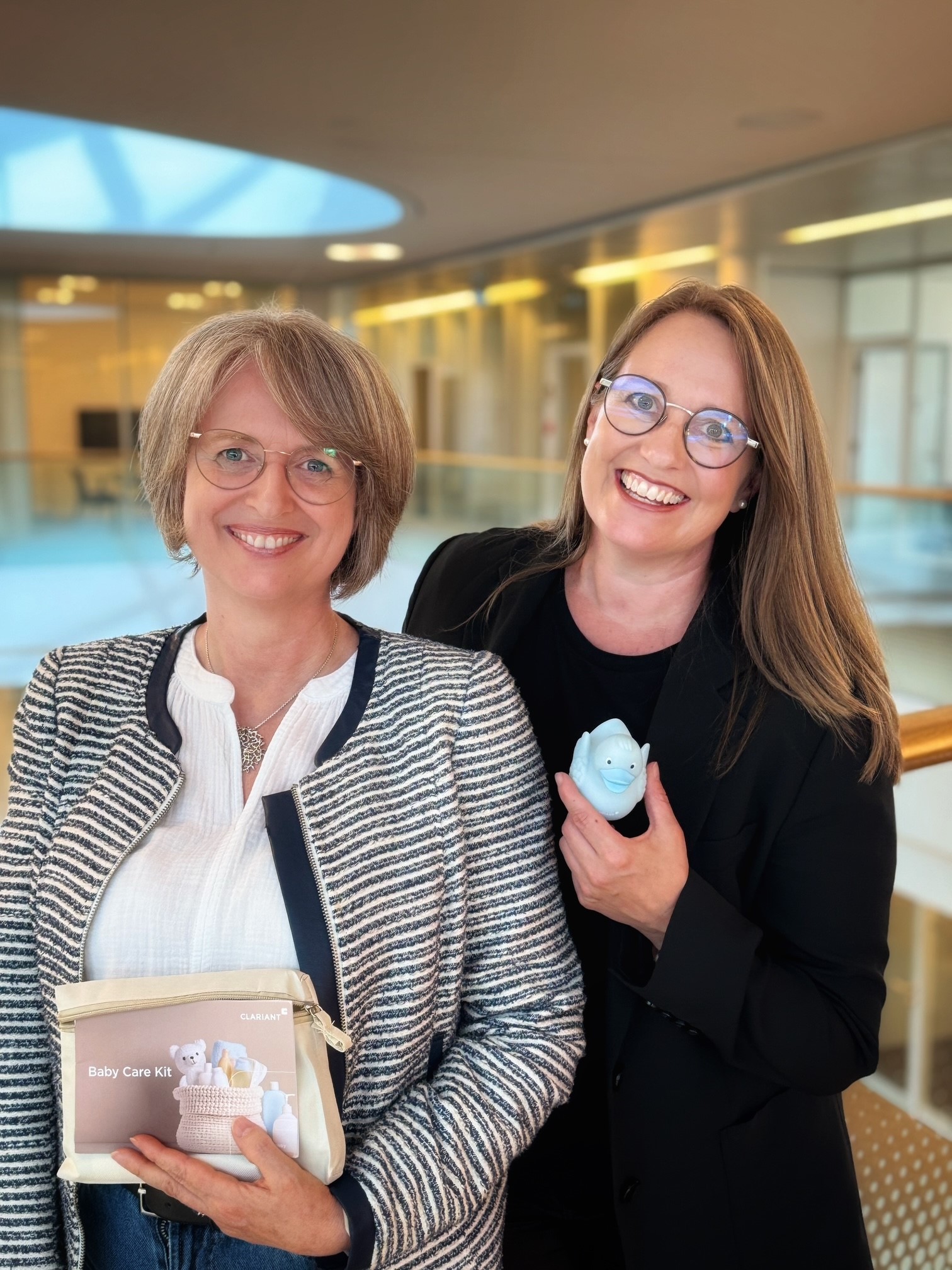
Our experts: Ute Back (left), Technical Application Manager Personal Care, and Petra Riederle (right), Business Development Manager
What’s next for smarter baby care preservation?
Baby care preservation is moving beyond single preservatives. Formulators increasingly need systems that combine reliable microbial protection with mildness, formulation flexibility and ingredients with a high proportion of renewable carbon.
The Velsan family supports a more holistic approach to baby care across different formats. However, the right solution depends on the complete formulation, manufacturing process, packaging, and intended use. Therefore, testing the finished product remains essential.
Frequently asked questions
Baby skin is still developing and can be more prone to dryness and irritation. Baby care products are also often used in humid and warm environments and handled repeatedly. A validated preservation system helps prevent bacteria, yeast and mold from growing in the formula during shelf life and use.
Common routes include hands, contact with skin, water splashes, airborne microorganisms, open packaging and accidental dilution. Raw materials, processing and filling must also be controlled during manufacturing.
Candida albicans is a yeast strongly associated with candidal diaper dermatitis and is frequently present when diaper dermatitis occurs. A cosmetic preservation system that is active against Candida albicans helps control growth in the product. It is important to note that this system does not prevent or treat medical skin conditions.
A preservation booster improves the performance of the overall preservation system and can help reduce the concentration of traditional preservatives needed for adequate formula protection. Performance depends on the complete formulation.
Velsan CGE is well suited to oil-containing leave-on formats, including diaper balms and ZnO creams. It is available in the oil phase and can add emollient, pigment wetting and pigment dispersing benefits.
Velsan Flex is designed for highly aqueous formulations. Its high water solubility and pH stability provide flexibility in rinse-off products and wipes..
Yes. The finished formula must be tested because antimicrobial performance depends on the complete composition, manufacturing process and packaging. ISO 11930 is a commonly used reference method for evaluating antimicrobial protection of cosmetic products.