
Advancing plastics recycling
to reach global goals
The Sustainable Development Goals of the UN, a set of 17 social and environmental goals the world wants to reach by 2030, are like a huge puzzle where everything has to fall into place to yield a sustainable whole. One of the most important pieces of the puzzle is SDG 12, »Responsible Consumption and Production,« which calls for sound management of our resources and waste. Reducing the footprint of plastics naturally plays a major role in this, and is a central part of Clariant’s sustainability strategy.
Since 2019, we’re not only founding member of the Alliance to End Plastic Waste but also support the shift to a circular plastics economy with our own company-wide initiative EcoCircle. The initiative provides a new platform for working and collaborating on the three big Rs of plastics circularity: reduction, reuse and recycling. One of our EcoCircle solutions for reducing plastics, for instance, allows condensing products like shampoos and suntan lotions into solid, water-free formats, which saves up to 60% of their packaging. And the platform is also the perfect place for using our deep expertise in specialty chemicals to enhance both the traditional and – highly promising – new ways of plastics recycling.
The still by far dominant method for valorizing used plastics is mechanical recycling. This is what happens to returned PET bottles and certain other plastics sorted from bins, and it essentially consists in washing, shredding and melting plastic scrap into pellets so it can be used anew. One problem is that the resulting post-consumer resins, or PCRs, are usually of lower quality. This means they have to be downcycled from, say, a plastic bottle to a fleece jacket to a picnic table – which will then likely drop out of the plastics loop entirely.
Clariant can make plastics more resistant to such degradation with additives, whose own sustainability is something we particularly focus on. These additives protect the polymer chains of plastics from being broken up by heat or water, which makes products last longer and their plastics able to go through more recycling rounds. Other additives of ours enhance the compatibility of PCRs with virgin plastics, enabling more recycled content in premium applications like bottles and films. And for the de-inking and washing necessary prior to recycling, we offer highly effective detergents.
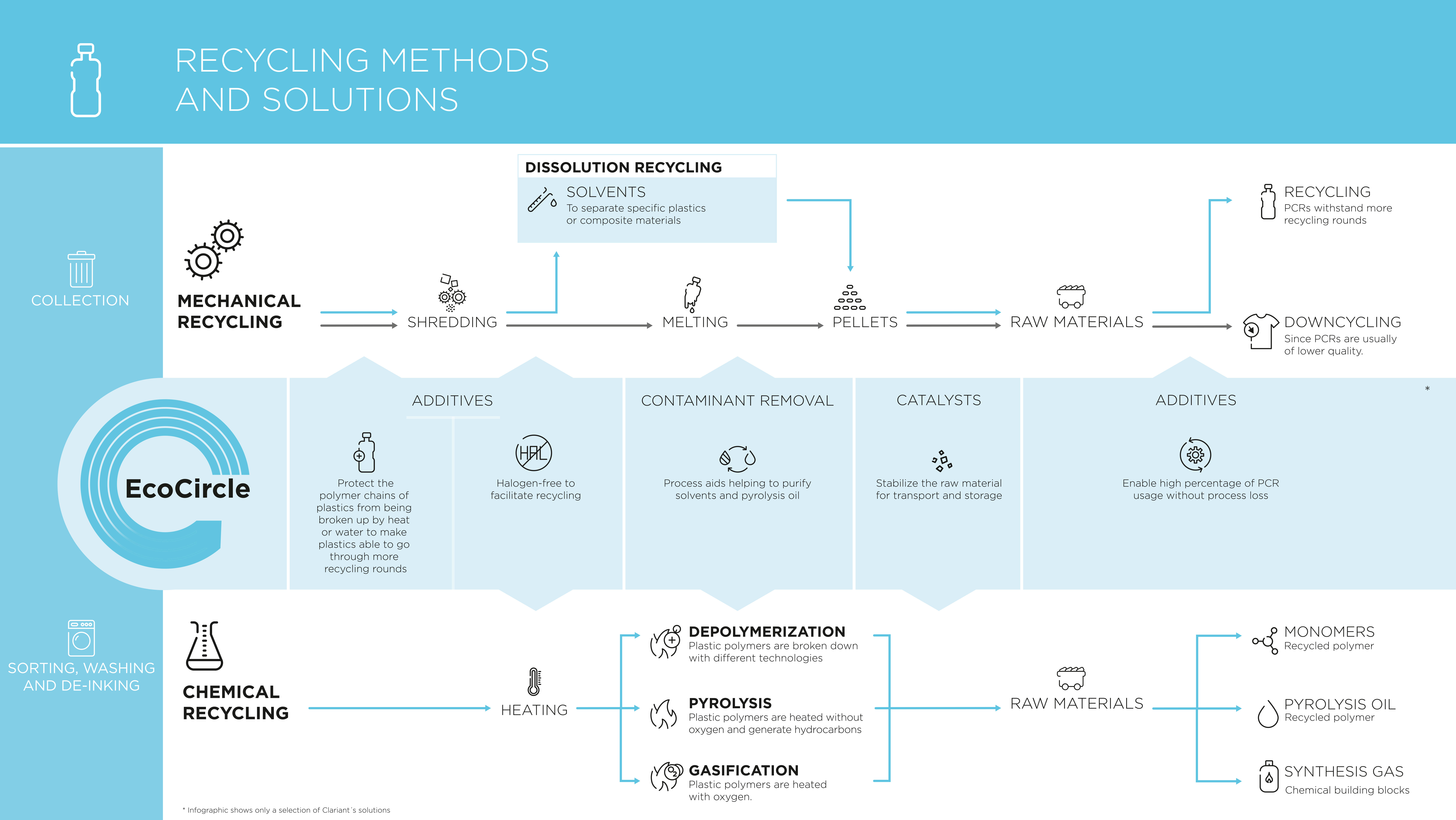
Click to zoom the graphic or download it at the end of this page.Another more recent method of mechanical recycling is dissolution recycling, which uses solvents to separate specific plastics from the kind of mixed plastic waste traditional recycling finds hard to handle, or even from composite materials like multilayered food packaging. As a highly promising form of advanced recycling, this solvent-based method is sometimes erroneously referred to as chemical recycling, or grouped with other new methods under this term. Yet unlike these, it does not alter the chemical structure of the plastics treated, as depolymerization for instance does. In this form of – aptly termed – chemical recycling, solvents and other substances are used to break up the polymer chains of plastics in unrecyclable materials like carpeting, so that their chemical building blocks can be saved.
Clariant has process aids helping to purify the solvents used in both methods. And in a collaboration between Clariant and the famous German Fraunhofer Society, – which developed a solvent-based recycling process – obstacles to recycle carpets and similar textiles have been removed, which our innovative Licocene performance polymers render much easier to reuse.
Another highly interesting new form of chemical recycling, and one that is especially tolerant regarding plastics mix and quality, is pyrolysis. In this method, high heat is used to break up the polymer chains of all plastic types in the waste, whose gasified components are then condensed to so-called pyrolysis oil. Yielding the same virgin-grade plastic building blocks when cracked as fossil oil, this oil could theoretically extend the recycling loop to infinity, but must be free of impurities to do so. Again, Clariant has the right purification aids for the job, as well as catalysts stabilizing the oil for transport and storage. This helps ensure that it is really used for new products and not simply for heating – an on the whole acceptable yet uncircular manner of valorization.
Taken together, the widely used traditional and budding advanced methods of recycling plastics have the potential to make it at once more comprehensive and more precise. And our EcoCircle initiative plays an important role in identifying and promoting required approaches, such as those mentioned in this article, to further develop these methods.
At the same time, by cooperating with others to enhance them with our chemical expertise, we’re actually not just supporting SDG 12 but also another important global goal: SDG 17 – using partnerships to make the whole puzzle work.